What is a via ferrata? And why you don’t need to be a climber to try one
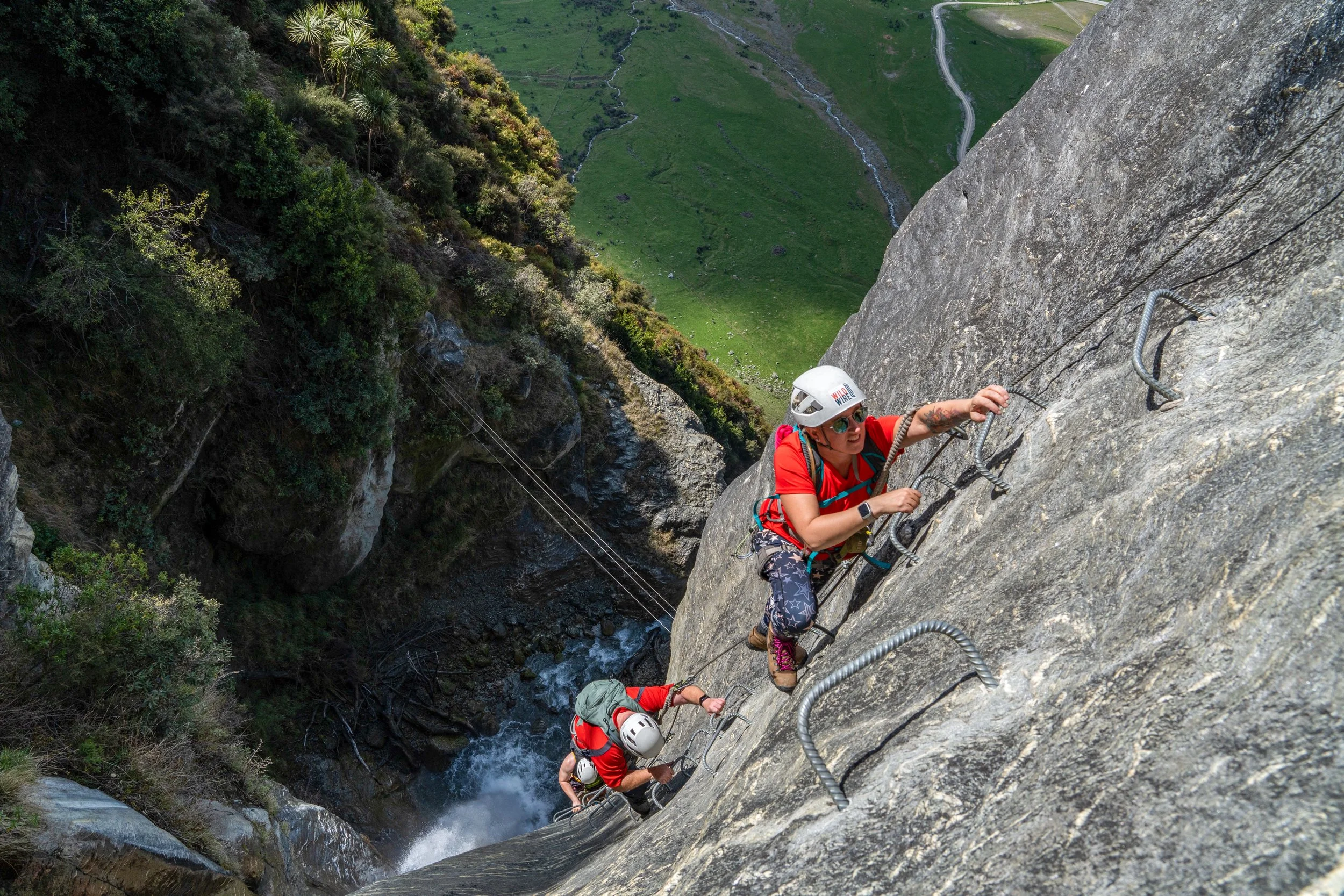
A via ferrata is a protected climbing route that uses a fixed steel cable, together with iron rungs, ladders and bridges, to help people move safely through steep mountain terrain. The name is Italian: via means “way” and ferrata comes from iron – the “iron way”.
It sounds technical. The experience doesn’t have to be. You don’t need climbing experience, you don’t need to know knots, and you don’t need to be an athlete. At Wildwire, we often put it much more simply: if you can climb a ladder, you can climb a via ferrata.
That is part of what makes it such an unusual adventure. A via ferrata can take someone who has never considered themselves a climber into terrain they would never otherwise expect to reach – one rung, one clip and one step at a time.
At Wildwire, that terrain happens to be beside Twin Falls near Wānaka, where our routes climb alongside a waterfall for hundreds of metres. Most people arrive wondering, “Can I actually do this?” The best part is watching that question change as they climb.
So, what actually happens on a via ferrata?
Think of it as somewhere between a mountain walk and rock climbing, but without needing the technical climbing skills you would normally need to move through steep terrain.
You wear a harness and are connected to a fixed steel safety cable as you move along the route. Iron rungs and ladders provide hand and foot holds where the rock becomes steep, while bridges and other features help you cross sections of the mountain.
The important bit is that you are still doing it yourself. You climb every rung. You cross the bridges. You make the decision to keep moving.
That is very different from an adventure where the experience is effectively done to you. On a via ferrata, you are in it. The safety system and your guide are there to support you, but nobody can climb it for you.
And that is exactly why reaching the next ledge – or eventually looking back at how far you have come – can feel so satisfying.
Why is it called the “iron way”?
The story of via ferrata is part of what makes it fascinating. The routes are strongly associated with the Italian Dolomites, where iron cables, rungs and other fixed aids were used to help people move through extraordinarily steep mountain terrain.
During the First World War, these routes became a way of moving soldiers through the Dolomites without requiring them to be trained mountaineers. The mountains were part of the front line, and fixed routes helped make otherwise difficult terrain accessible.
More than a century later, the idea remains remarkably simple: give people a secure way to move through terrain that would otherwise demand much more technical climbing experience.
For us, that history is more than something we have read about. Mark and Laurel travelled to the Dolomites and spent ten days climbing original via ferrata routes, moving through old tunnels, trenches and mountain positions that still carry traces of that history.
That trip would later influence the feel of Wildwire’s newest route, The Wild Thing. It deserves a story of its own.
Do you need climbing experience?
No. And this is probably the misconception we most want to get rid of.
Many Wildwire guests have never climbed before. Some are comfortable with heights; plenty are not. Often we have couples where one person has climbed or adventured before and the other has very little experience. A via ferrata gives them a way to share the same adventure.
It is also not simply a test of strength or speed. You move at the pace of the group, listen to your guide and work your way through the route one section at a time. Focus and nerve can matter far more than brute strength.
You need to be active enough to climb a ladder and spend time moving outdoors, but you do not need to turn up looking or feeling like a climber.
Curiosity helps. So does being willing to take the first step.
What does a via ferrata feel like at Wildwire?
Wildwire is a little different from the picture you might have in your head of a traditional via ferrata.
Most routes around the world follow a rock face or mountain. Ours follows Twin Falls near Wānaka. That is why we describe Wildwire first as a waterfall cable climb and use via ferrata to explain how it works.
As you climb, the route unfolds around the waterfall. There are rungs, bridges and sections of rock, but there is also the water, the noise, the landscape and the feeling of moving higher through a place you could not experience from a walking track below.
Wildwire has three Lord of the Rungs climbs – Level 1, Level 2 and Level 3 – as well as The Wild Thing on the right-hand falls. That gives people somewhere to start and, importantly, somewhere to come back to.
But the height is only part of the story. What stays with many people is the fact that they did it themselves.
They arrived unsure. They took the first rung. Then another. Somewhere along the way, “Can I do this?” became “I’m doing this.”
And by the end, the question can become something else entirely: “What else am I capable of?”
Is via ferrata safe?
A via ferrata is designed around a fixed safety system. At Wildwire, climbers are connected to the steel cable as they move through the route, and a guide is with the group throughout the climb.
But good guiding is about more than equipment. People respond differently when they are challenged. Someone can be physically capable and still reach a point where the exposure suddenly feels very real.
That is where the human side matters. As Laurel puts it, a Wildwire guide can be part climbing guide, part counsellor.
Sometimes the next step is not technical at all. Stop. Breathe. Look at what is directly in front of you. Then go again.
We think of safety as what allows adventure to happen. The point is not to make people fearless. It is to give them the systems, support and confidence to do something that feels brave.
Which Wildwire climb should I choose?
You do not have to start with a climbing background – and you do not necessarily have to start with the smallest possible adventure. The right climb depends on the experience you want, your comfort with heights and how much time you want to spend on the waterfall.
Lord of the Rungs Level 1 – An introduction to the Wildwire experience and a natural starting point for first-timers.
Lord of the Rungs Level 2 – A bigger step up the waterfall and the classic Wildwire experience.
Lord of the Rungs Level 3 – The full Lord of the Rungs ascent for those wanting to take the adventure higher.
The Wild Thing – A different route on the right-hand falls, influenced in part by Mark and Laurel’s experience climbing original via ferratas in the Dolomites.
The climb pages carry the detailed requirements for each option. If you are unsure which one fits, that is a good question to ask before you book.
The first step is usually the hardest one
People sometimes look at photographs of Wildwire and decide the people in them must be climbers.
Usually, they are just people.
People on holiday. Couples looking for something memorable to do together. Someone who loves heights beside someone who absolutely does not. People who want an adventure but do not necessarily think of themselves as adventurous.
That is exactly who via ferrata opens the mountains to.
You do not have to know what you are capable of before you arrive. In fact, discovering that is rather the point.
-
Description text goes hereVia ferrata is Italian for the “iron way” or “iron path”, referring to the fixed iron and steel features used to move through steep mountain terrain.
-
No. Wildwire is designed to be accessible to people with no climbing experience. Your guide takes care of the technical side and shows you how to use the system.
-
You need a reasonable level of everyday activity, but you do not need to be an athlete. A useful rule of thumb from the Wildwire team is: if you can climb a ladder, you can do a via ferrata.
-
Yes. Many Wildwire guests are first-time climbers. The best climb for you depends on the experience you want and your comfort with heights.
-
Wildwire is at Twin Falls near Wānaka, New Zealand, on private land in the Mount Aspiring landscape.