Inside The Wild Thing: what does a mountain guide look for?
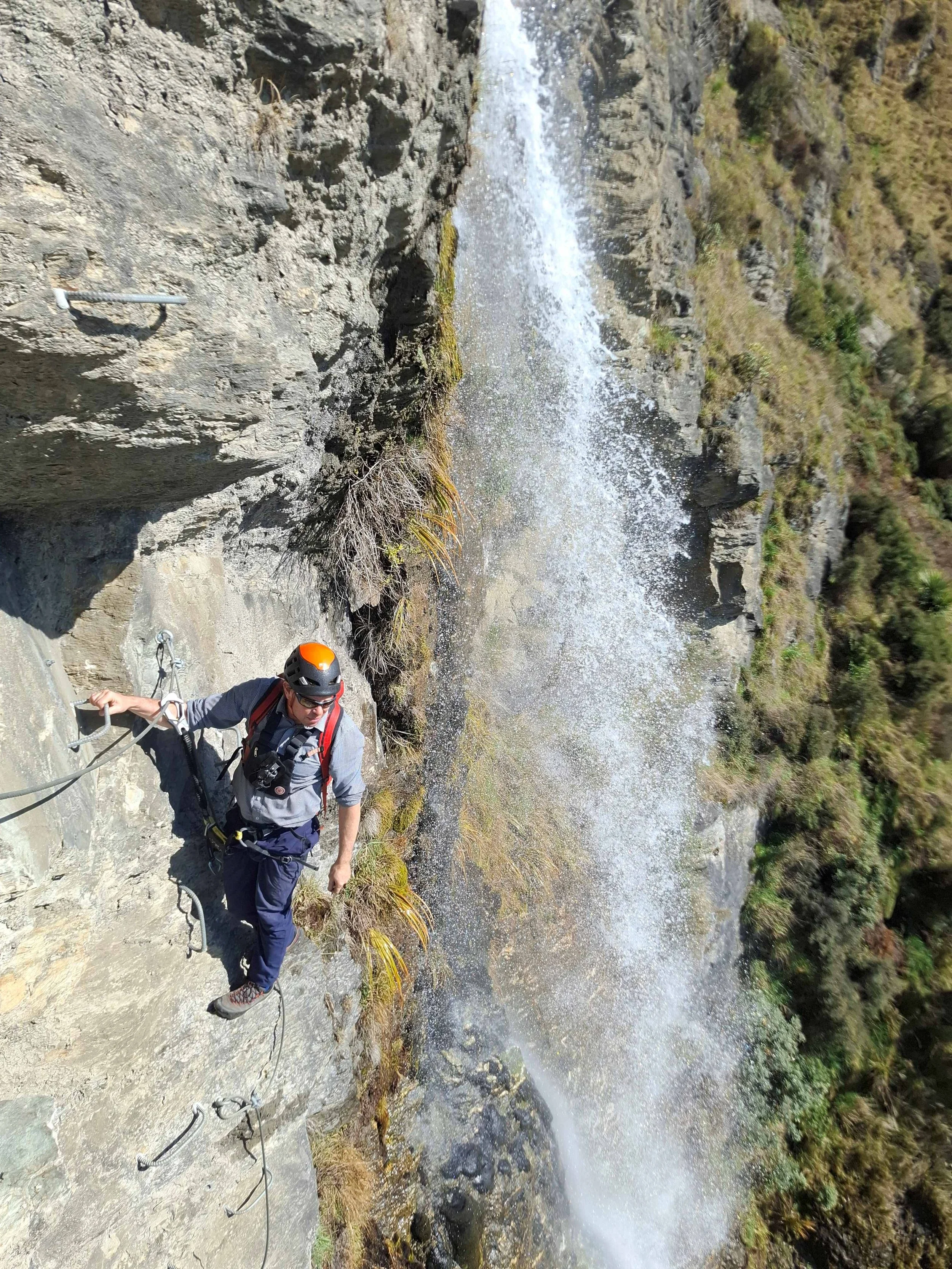
When mountain guide Tim Robertson climbed The Wild Thing for the first time, he wasn’t only looking at the route. He was looking at the people who will climb it, what happens when someone gets nervous, and how a guide keeps the whole group moving safely.
Tim has guided around the world, including five years in Switzerland, where he climbed via ferratas up to K5, including one around 500 metres vertical. He’s also known Wildwire co-founder Mark since Wānaka’s climbing scene in the mid-90s.
Tim was brought in to help Mark and the Wildwire team think through how The Wild Thing will be guided. So after his first climb, we asked what he was looking for.
What does a mountain guide look for in a via ferrata climb?
For Tim, assessing a route is as much about people as it is about the climbing.
“You’re trying to assess how you deal with somebody who gets overloaded. Whether you can manage them going up … or whether you bail off. Whether you can keep them in sight and keep control of the situation.”
Because people don’t necessarily behave as you expect when they’re scared. As Tim puts it, “Stressed people, it’s really surprising what they do.”
And stress can travel through a group.
“If one person is stressed, it stresses other people out. If you’ve got a good management strategy that keeps them calm, and they can see it’s quite robust, then that pressure’s gone. They don’t feel like a mistake is the end of the world, and everybody calms down because you’ve got a good plan to manage it.”
That means thinking ahead about where a guide can see everyone, how the group moves through different sections and what the options are if someone becomes overwhelmed.
What keeps a challenging climb safe?
Tim uses what he calls a four-pillar approach.
The first is being in the right place at the right time.
For The Wild Thing, that includes the conditions. As Tim explains, you probably don’t want to be out there “when it’s super windy and you’re getting blasted with water and spray”.
The second is having the right guide with the right group.
The third is making sure everyone knows what they’re supposed to be doing the whole time.
And the fourth is the guide’s rope systems.
“The rope systems are there and they should work, but you shouldn’t really need them if you’re doing the first three.”
To be clear, climbers on Wildwire are connected to the steel safety cable throughout the route. Tim is talking here about the additional rope systems guides carry and can use if someone needs extra assistance.
His approach is about managing things well before those systems are needed.
How does The Wild Thing compare with via ferratas in Europe?
This is where Tim’s experience in Switzerland gives him an interesting perspective.
Traditional via ferrata can involve much more movement on the rock itself, with the cable alongside the climber and rungs only where they’re needed. Modern routes tend to use more built features to take climbers into steeper terrain.
Tim sees a bit of both in The Wild Thing.
“It’s quite a mix, because it’s got some moves on real rock. You do actually do some real climbing and it’s not always rungs.”
He describes it as a mix of “the new style, where it’s steep and you’ve got rungs, and the traditional style, where you climb the natural features.”
Some of the steeper sections stood out.
“It feels like proper climbing. You’ve got to get your balance right. You’ve got a straight-arm hang, and you’ve got to kind of monkey about. If you pull up too much and you’re in the wrong place, there’s a bit more thinking.”
Or, as the conversation eventually settled on: it’s more thinky.
The setting feels different too.
The existing Lord of the Rungs route follows the left-hand side of Twin Falls and, in Tim’s words, feels “quite intimate, like being in a canyon”.
The Wild Thing is much more open.
“This one’s on top of a big face, like a big wall.”
From the route, Tim says you can see right up to the top of the lake and all the way back down towards the car. You’re also closer to the waterfall spray.
The rock itself is different. Tim noticed greenschist that hasn’t been polished as much by the waterfall, and fewer of the larger ledges found on the original route.
“The original one’s way more ledgy than it looks, and this one isn’t really that ledgy. The ledges are all quite small. So maybe it’s more sustained.”
It sits right beside the existing climb, but it feels quite different.
Who is The Wild Thing for?
For Tim, a good challenge needs to give you a reasonable chance of succeeding.
“If you’re trying to do something you physically can’t do, even if you’re doing your best, it’s not that fun for most people.”
But it shouldn’t be a walk in the park either.
“It’s that thing where it pushes you, but not too much.”
And heights are interesting. Tim puts it rather well: if you really don’t like them, “it’ll be like going to the dentist: you just close your eyes and wait till it’s over.”
But that’s not the only way people approach a climb.
“Maybe you don’t like heights, but you like challenging yourself.”
When Laurel asked who he thought would enjoy The Wild Thing, Tim’s first thought was people who have already climbed Level 2 or Level 3 and want more of the same.
A new route. A different style of climbing. And enough challenge that you have to think and work a few things out along the way.
More about Tim Robertson
Tim Robertson is a fully certified IFMGA and NZMGA mountain and ski guide and co-owner of Peak Experience NZ, a small Wānaka-based guiding company. He has guided in New Zealand and around the world, including five years in Switzerland. He now splits his time between Wanaka/Lake Hawea New Zealand and Interlaken Switzerland.
The Wild Thing
The Wild Thing is Wildwire’s newest route at Twin Falls in Wānaka. Bookings open 1 December.
Find out more about The Wild Thing →
Interview by Laurel Morrison, Director and co-founder of Wildwire Wānaka, with mountain guide Tim Robertson after his first climb of The Wild Thing, October 2026.